



 69 / 88

 www.truckandtrack.com
Spring 2019
Truck and Track
69
DANGEROUS GOODS
GL: At this time, I do not see these requirements extending to the
road and sea modes. But who knows what the future holds, if
the work of the G27 results in a significant cost-effective safety
enhancement, which could benefit all modes, then no doubt this
could be a consideration.
RS: If batteries are damaged, how can they be shipped?
GL: Batteries that are damaged or defective, such that they have
the potential of producing a dangerous evolution of heat, fire or
short circuit, are forbidden for transport by air. Examples of such
batteries would include those being returned to the manufacturer
for safety reasons or those that cannot be diagnosed as damaged or
defective. The road and sea modes have Packing Instructions that
provide for batteries that, for example, have leaked or vented or are
subject to recall, but for those liable to rapidly disassemble or catch
fire etc, approval from competent authorities would be required.
RS: I have a hybrid car andwas wondering if vehicles likemine need to
be classified as dangerous goods when they are being shipped?
GL: Hybrid cars, i.e. those that are powered by an internal
combustion engine and a battery, are assigned to UN3166 “Vehicle,
flammable gas powered” or “Vehicle, flammable liquid powered”,
as appropriate. Vehicles only powered by batteries are assigned to
UN3171, “Battery powered vehicle”. Varying degrees of regulation
apply to them depending on the mode of transport, with ADR (and
IMDG to a lesser extent) allowing them, subject to conditions, to not
be subject to the requirements.
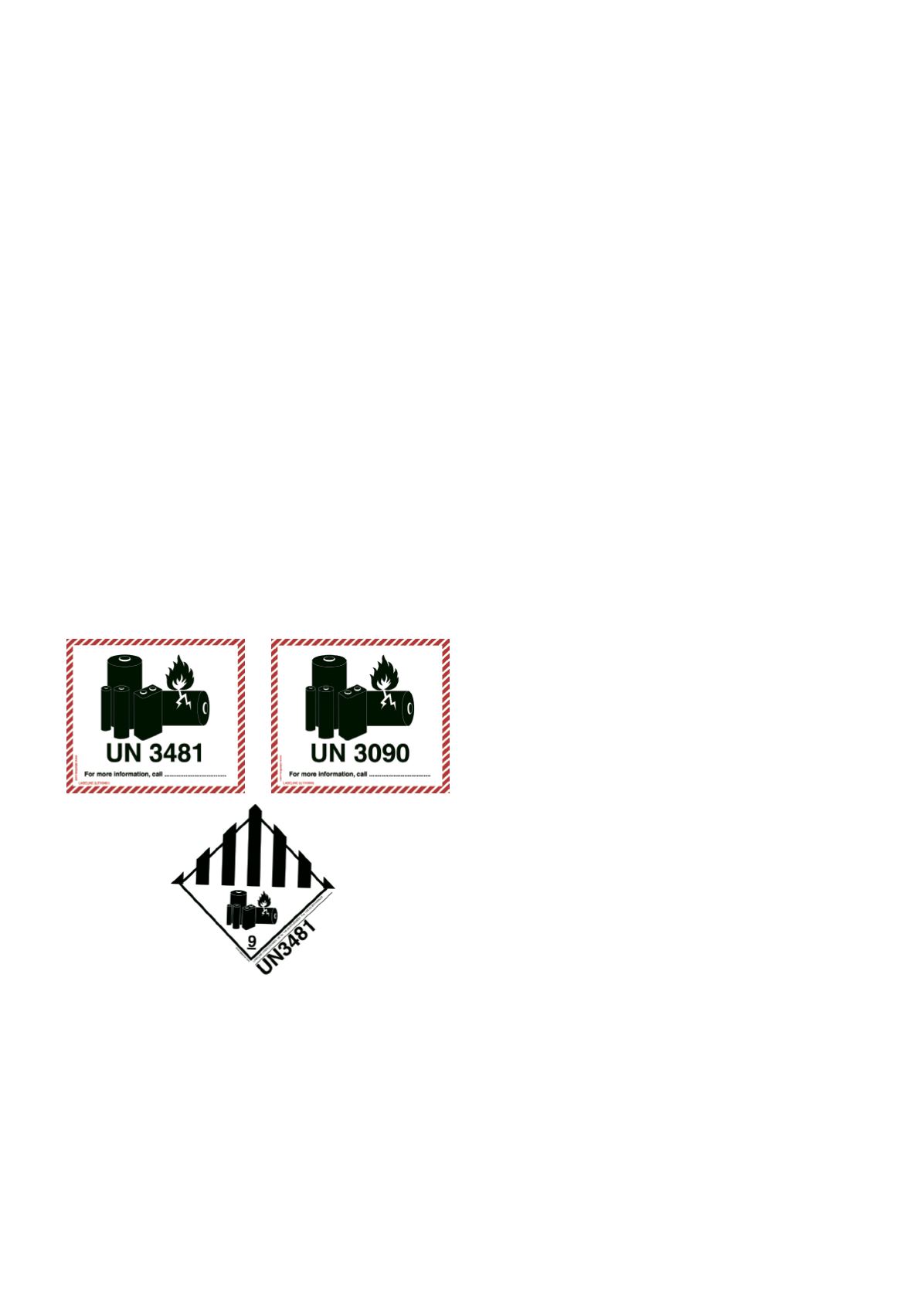
RS: At Labeline, we hear quite a lot from shippers who have had
consignments rejected for incorrectmarking. The newLithiumBattery
Handling marks and Class 9A hazard labels, like those shown below,
have been around for quite a while now. Are the old ones allowed by
any mode or should they all be disposed of?
GL: In its original guise, the lithium battery handling label was only
used in air transport. It was subsequently adopted by the UN and,
by default, the other modes, as the lithium battery mark. There was
a two-year transition period in air transport to use either version,
but this expired on 31 December 2018 and so now, all old lithium
battery handling labels should be disposed of. Similarly, when
required, the Class 9 lithium battery hazard warning label must
now be used; the transitional periods to allow for the use of the
Class 9 hazard warning label also ceased on 31 December 2018.
RS: We also hear from companies whose staff have attended CAA-
accredited three-day shippers courses for dangerous goods by air,
even though they are only dealing with lithium batteries. Does this
mean that they are qualified to ship lithium batteries by air?
GL: All modes of transport require “general awareness/
familiarisation”, “function specific” and “safety training” for anyone
shipping dangerous goods, including lithium batteries. General
three-day courses provide the general familiarisation training, but
it is a popular misconception that passing such a course qualifies
someone to ship any type of dangerous goods. Some years ago,
I was involved in a case at the CAA where a shipper of chemical
oxygen generators argued unsuccessfully that having been on a
three-day general course (where oxygen generators were never
referred to) they were trained as required by the regulations. The
judge upheld our view that no three-day course in the world can
cover the specifics of the 3000 or so dangerous goods listed in the
regulations. Further “function specific” training may be required
depending on what is covered in the general course.
For example, regarding lithium batteries, the CAA exam for a
general course will contain one question on lithium batteries,
which a student can get wrong but still pass the overall examand so
be “qualified”! Consequently, in conjunction with Labeline, we offer
a one day “add-on” lithium battery course for students attending
our three-day general (CAA approved) dangerous goods course, or
a two-day specific course for those interested in shipping lithium
batteries only. Air, sea and road mode requirements are covered.
About Geoff Leach
Geoff joined the Dangerous Goods Office at the Civil Aviation
Authority in 1990, becoming the Deputy Head of the Office in
1993. In 2002 he became Head of the Office and was elected
Chairman of the ICAO Dangerous Goods Panel (DGP, that develops
the international requirements for the safe transport of dangerous
goods) in 2007, having attended all previous meetings since 1992.
He left the CAA in 2014 to set up his own dangerous goods training
and consultancy business, which is Labeline’s appointed CAA-
accredited training partner.
Geoff continues to attendDGPmeetings on behalf of the Dangerous
Goods Advisor Council of the US, he Chairs the IATA Lithium Battery
Workshops and is a primary presenter at the Biennial Dangerous
Goods Roadshow.
He is also a DGSA and has appeared on the BBC discussing the
potential risks posed by fires involving lithium batteries
In 2016, Geoff received the George L. Wilson Award, considered the
highest form of recognition for an individual based on a lifetime of
achievement in advancing the cause of safety in the transport of
dangerous goods.
About Labeline
Established over 25 years ago by the MD, Keith Kingham, Labeline
International is the world’s largest distributor of Dangerous Goods
regulations. The company supplies the full range of compliant
hazard and handling labels and provides dangerous goods training
to cover all modes. Labeline provides product-specific training for
the safe transport of lithium batteries, perfumes and fragrances,
gases and aerosols etc. These can be held in-house at your
company’s premises or you could attend one of our open courses
at Gatwick.
Our trainers are Geoff and his successor at CAA, Ross McLachlan,
who is also a former regulator. As they both helped to write some
of the regulations, they are well placed not just to explain the rules
but give the reasons behind them. All Labeline courses for air are
CAA-accredited.
For more information on lithium battery compliance materials
and details of upcoming training courses, please visit
www.labeline.com orcontact Richard Shreeve: 0870 850 5051 /
compliance@labeline.com.