



 49 / 88

 www.truckandtrack.com
Spring 2019
Truck and Track
49
LOADING BAYS
with tail lifts incorporating extra large protruding locking plates
that extend as much as 250mm from the back of the vehicle. If
the door is not wide enough, the locking plate can (and regularly
does) cause real damage to the doorjamb and external cladding.
It is becoming commonplace to see a wide range of vehicles at the
dock, including double deck trailers. It therefore pays to discuss
your current fleet and contractor’s/suppliers’ vehicles and your
likely future fleet with the loading bay technical salesman.
Yard slopes
The optimum slope is 1:80 away from the dock - this negates the
slope that the “5th wheel” puts on the trailer. That said, many
service yards are by no means perfect and compound slopes are
much in evidence. This is where two opposing slopes create the
required slope. Often a slope away from the dock is formed to a
drainage channel and then a slope up to form a compound 1:80.
Steep slopes into the dock cause real problems with rain running
of the roofs of trailers into the building as well as wheeled loads
tipping out of trailers when the doors are opened. It is also common
to find damage to the head of the door because the top of the trailer
arrives before the buffers have had the chance to stop it. (See also
door size problems)
In this instance, to prevent damage to the building fabric, the first
thought is to pack out the dock bumpers. This of course works but
then often a longer lip is needed on the dock leveller to allow the
correct interface with the reversing vehicle. The resultant costs to
correct things later can be several hundred pounds for each bay.
This can be avoided by getting good advice from the outset.
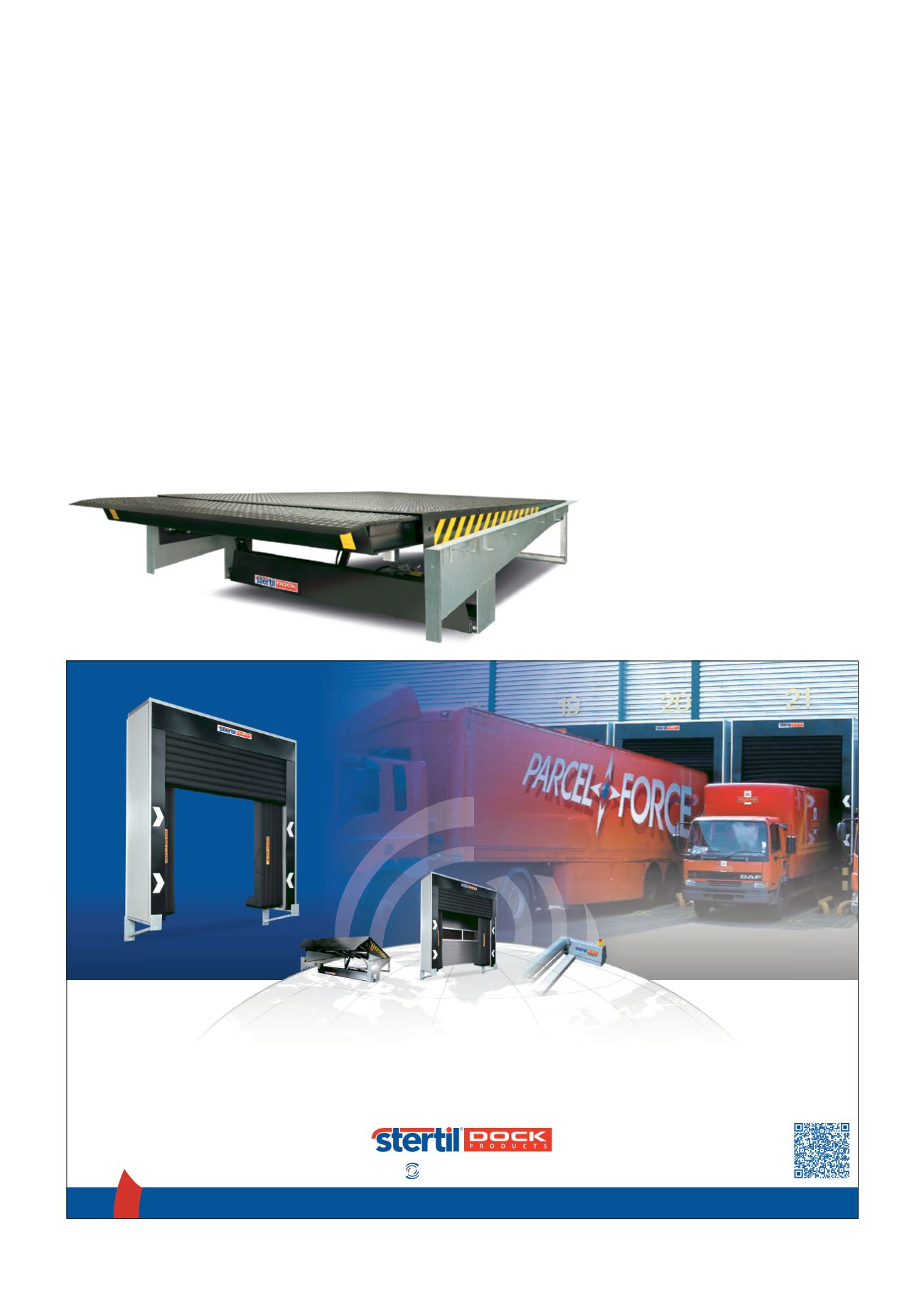
Dock leveller sizing
This applies to both the capacity and the dimensions of the dock
leveller. Too narrow - and loading and unloading of the first two
pallets in the rear of the trailer will be problematic, especially
without a fork truck. Too wide - and narrower vehicles cannot be
unloaded.
The length is critical in terms of the gradient of the platform. EN
1398 requires that the maximum slope be designed not to exceed
1:8 (about 12.5%) although as a rule of thumb 1:10 is quicker to
calculate! And errs on the safe side. It is important to calculate the
platformgradient excluding the lip of the leveller as this is generally
designed to be in a different plane and inside the vehicle anyway.
Once again, information about vehicles intending to use the dock
is most important. Capacity of the dock leveller is rated on the way
a load is imposed on the platform. Ask your intended supplier what
single axle load has been used to calculate the capacity. The more
robust dock levellers are designed using a single axle load of the
rated capacity i.e. 6000kg rated leveller designed on 6000kg single
axle load.
So, as you can see, the road to the correct selection of a loading bay
contains pitfalls - most can be avoided by
talking with the industry experts.
Stertil Dock Products has published a
useful guide -
How to Design A Loading
Bay
- which provides many practical hints
and tips both about loading bay design and
how to get the information necessary to
put the design into practice.
Stertil Dock Products
www.stertil-dockproducts.co.uka member of the Stertil Group
Tel. 0870 770 0471,
info@stertil.co.uk, w ww.stertil-dockproducts.co.uk• Versatile:
Accepts double decker
vehicles and most HGVs.
• Efficient:
Reduces energy loss and
maintains internal environment.
• Easily Retro Fitted:
Custom made
to suit building profile.
• Demonstrations:
Available at our
Northampton demo theatre.
• Reduced Maintenance:
Eliminates
damage caused by Double Deckers
on conventional shelters.
• Free Survey
.
Double Deckers Welcome
A virtually airtight seal for a greater range of vehicle heights