







25 years, one network, one team: UPN marks a quarter-century on the road
25 years, one network, one team: UPN marks a quarter-century on the road
25 years, one network, one team: UPN marks a quarter-century on the road
From a celebratory fish-and-chip lunch to a fireworks finale over its Staffordshire SmartHUB, United Pallet Network has marked 25 years in business. But behind the anniversary celebrations is a bigger story: how a network built around independent hauliers has grown into a nationwide pallet operation shaped by technology, service quality and an increasingly serious approach to sustainability.
For United Pallet Network, 4 June 2026 was more than another date on the calendar. It marked 25 years since the company’s first official day of trading, and UPN chose to celebrate the milestone in a way that reflected the culture it has tried to build over a quarter of a century: together.
Staff gathered at the company’s SmartHUB for a team lunch served by JOJO’S Fish & Chips, turning the working day into a relaxed opportunity for colleagues to sit down, talk and reflect on the journey. Later, as darkness fell, the celebration moved into a different gear. At 21:45, fireworks filled the sky above the hub, bringing the anniversary to a spectacular close.
The choice of soundtrack was fitting: Queen’s “We Are The Champions”. Yet the message from UPN was less about a single company declaring victory and more about the collective effort behind the network. Managing Director David Brown summed up the mood: “I am incredibly proud of what we have achieved together. Celebrating 25 years was a fantastic opportunity to bring Team UPN together, recognise how far we have come and thank everyone who has played a part in our success.”
From 2001 to a national network
UPN was established in 2001 with a straightforward but powerful idea: independent regional hauliers could achieve more by working together than by operating in isolation. The model was built around the familiar hub-and-spoke principle. Local members collect palletised freight in their own postcode areas, trunk it to a central hub for overnight sortation, and then take returning freight back into their regions for final-mile delivery.
It is a model that gives customers national reach while allowing independent operators to retain the local knowledge, relationships and flexibility that are often their greatest strengths. Twenty-five years later, UPN says its network has grown to more than 100 member depots, with UK-wide coverage and European services reaching 26 countries. The company describes that growth as deliberately measured rather than growth for its own sake, with member quality and service consistency placed ahead of simple scale.
The numbers illustrate how far the operation has come. UPN’s purpose-developed SmartHUB at Fradley Park, near Lichfield, covers around 300,000 sq ft and can sort up to 15,000 pallets per night. More than £3 million has been invested in the facility, while the wider network is supported by more than 5,000 local vehicles.
Every night, trailers arrive from around the country. Pallets are checked, scanned, sorted and assigned to outbound trunks before the process reverses for final delivery. The physical handling is highly visible, but the information behind each movement is just as important.
Technology as part of the infrastructure
UPN’s history is also a useful snapshot of how road freight has become increasingly digital. In 2006, the network introduced its first signature-capture system. A mobile Track and Trace app followed in 2013, European pallet services in 2014, SmartPOD electronic signature capture in 2016 and the paper-reducing SmartDOC system in 2017.
The shift accelerated in 2020 with the opening of SmartHUB and the launch of contactless cross-network SmartHUB IT. Two years later, SmartHUB 2 increased overnight sortation capacity to 15,000 pallets. In 2023 UPN introduced SmartSCORE, its customer-feedback platform, and in 2025 came SmartTRAK, a new freight-monitoring system designed to give customers live visibility of consignments.
SmartTRAK is a good example of how expectations in road transport have changed. Customers no longer simply want to know that freight is “out for delivery”; they increasingly expect the kind of visibility they receive in the consumer parcel market. UPN says SmartTRAK provides live mapping, real-time drop sequencing and dynamically updated estimated arrival times, while SmartPOD records GPS-stamped delivery information, signatures and photographic confirmation.
For member hauliers, that digital layer is not just a customer-service tool. Better information can reduce avoidable calls, improve planning and create a shared operating picture across more than 100 independent businesses. In a network environment, consistent data matters.
The independent haulier at the centre
What has not changed is the role of the regional transport operator. Pallet networks depend on local companies that know their territories, customers and delivery challenges in detail. A national brand may sit above the operation, but the freight is still collected and delivered by drivers working from depots embedded in their local areas.
That is why UPN’s anniversary theme — “25 years. One network. One team.” — feels more substantial than a marketing line. The network is made up of separate businesses whose performance is interdependent. A pallet collected in one member’s area may be delivered hundreds of miles away by another member the customer has never met. The service succeeds only if the handovers work.
Later, the fireworks provided the scale and spectacle expected of a major anniversary. UPN said the display was intended to recognise not only employees, but also members, customers and supply-chain partners who have contributed to the business since 2001. Brown has described the milestone as both an opportunity to look back and a point from which to consider what the next 25 years might bring.
A greener road ahead
One of the biggest challenges facing that next chapter is environmental performance. Haulage remains difficult to decarbonise at scale, particularly where long-distance trunking, heavy payloads and time-sensitive operations are involved. UPN has increasingly made sustainability part of its wider strategy, combining operational measures with carbon accounting and offsetting.
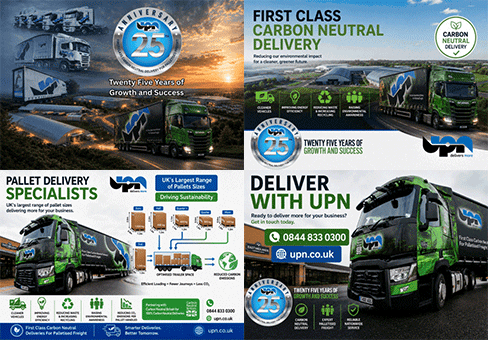
Since April 2024, the company has described all palletised freight handled through its member network as carbon neutral, with emissions measured and offset through a programme certified by Carbon Neutral Britain. UPN reports that between April 2024 and March 2025 it offset more than 28,500 tonnes of CO2e associated with 26 million road miles. It also achieved ISO 14001:2015 environmental management certification in 2025.
At hub level, the business says it has cut electricity use by 19 per cent, water consumption by 80 per cent and paper use by half, while replacing forklifts with electric units and reducing landfill waste to below one per cent. Its published roadmap includes customer-level reporting of carbon emissions per delivered pallet and a longer-term ambition to move more of the fleet towards electric operation.
Offset-based carbon neutrality is not the same as eliminating tailpipe emissions, and heavy transport still faces major questions around vehicle range, charging infrastructure and fleet economics. What is notable is that environmental reporting is moving from the margins of pallet distribution into day-to-day operational thinking.
The next 25 years
UPN reaches its 25th anniversary at a time when the fundamentals of road freight remain reassuringly familiar, even as the tools around them change. Pallets still have to be collected, trunked through the night, sorted accurately and delivered by people who understand the realities of the road. But the expectations attached to that process are higher than ever: real-time visibility, strong service data, lower environmental impact and resilience in the face of disruption are becoming standard requirements rather than added extras.
For UPN, the story of the past quarter-century is therefore not simply one of getting bigger. It is the story of connecting independent hauliers through shared infrastructure, common systems and a service promise that depends on every member doing its part. From early signature capture to SmartTRAK, from an 8,000-pallet hub in 2010 to a 15,000-pallet-per-night SmartHUB today, the network has steadily added capacity and technology while keeping the member model at its core.
The anniversary events gave Team UPN a chance to enjoy that progress. Lunch brought people together in daylight; fireworks lit the SmartHUB after dark. Between those two moments sat 25 years of night trunks, early starts, loading bays, route planning, customer calls, IT development and the countless ordinary decisions that make a transport network function.
That may be the most appropriate way to view UPN at 25. The milestone is worth celebrating, but the real achievement is not a single evening of fireworks. It is a network of independent businesses that has kept moving, adapting and delivering together since June 2001 — and which is already looking down the road towards the next quarter-century.

